Sunday, October 17, 2010

ATHERTON TABLELANDS - Curtain Fig Tree


Curtain Fig Tree, Atherton Tablelands

A ranger drew our attention to a Boyds Rainforest Dragon climbing up one of the roots of the curtin fig tree as it is so rarely seen. It is unique to this area of the rainforest and is in limited numbers. Although the quality of the photos is poor they have been included as a reminder of this special viewing.
Boyds Rainforest Dragon climbing up a root


The dragon dropped to the rainforest floor, scurried off and wasn't seen again

A female Golden Orb Spider identified by the yellow bands on her legs


ATHERTON TABLELANDS - Platypus Hunting

Our main reason for returning to the Atherton Tablelands was to hopefully see both a platypus and a tree kangaroo, the two major attractions in this area. We saw neither during a week of searching in 2007.

We spent hours walking alongside Petersen Creek and around Allumba Pocket, Yungaburra, in the hope of seeing a platypus.

Allumba Pocket was beautiful, like walking through well maintained grassy parkland

Swimming Hole

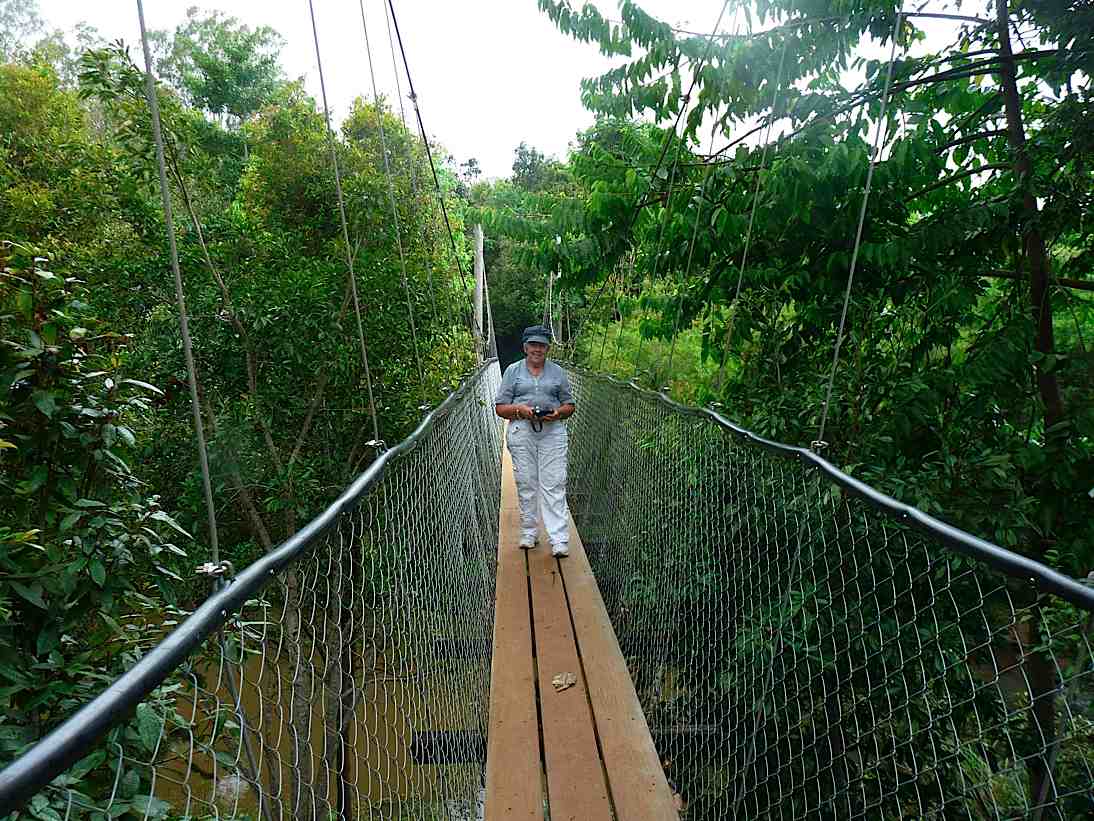
Swing Bridge over Petersen Creek

On our third attempt we were returning to our car when David spotted this platypus who swam on the surface of the water for approx. two minutes.

Just before dark on the same day we returned to see this platypus having a lovely time, diving and feeding. We were able to sit and watch him until dark, we were overjoyed.

ATHERTON TABLELANDS - LAKE EACHAM


Lake Eacham is a Crater Lake and is a popular swimming and picnic area surrounded by rainforest. There is a 3 km bushwalking track around the lake.

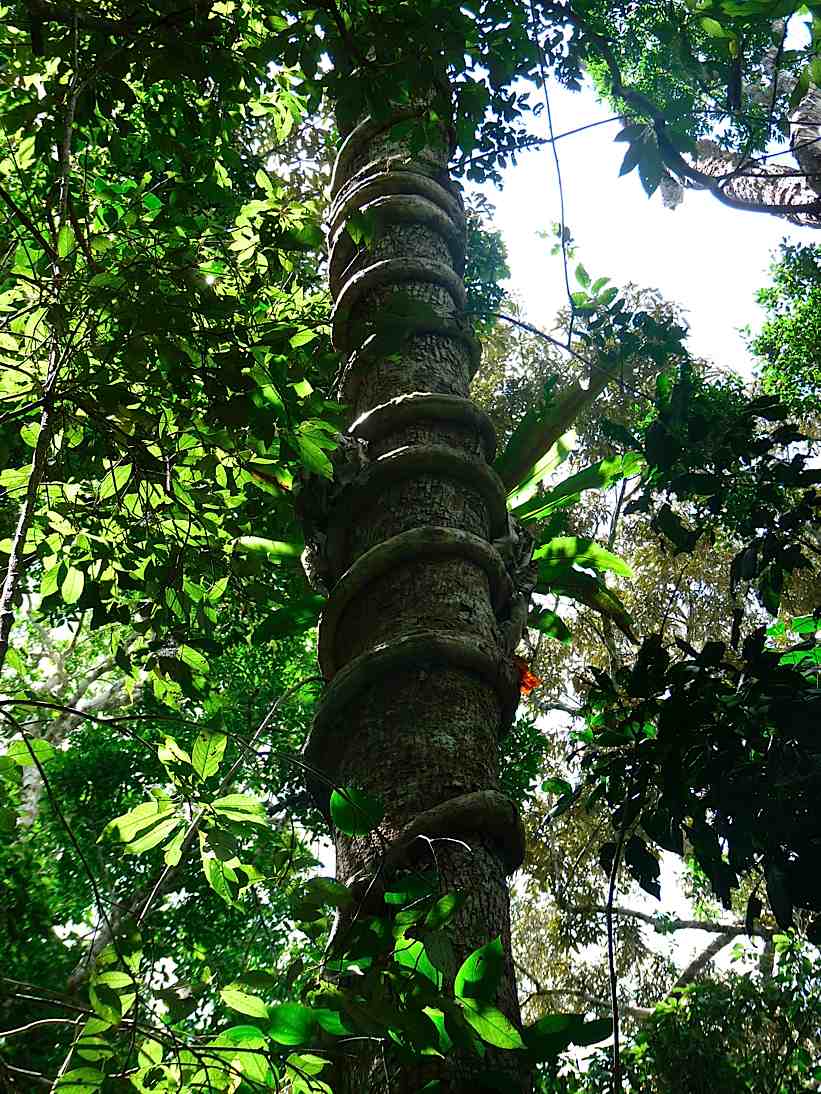
We are always surprised with the intricacies of nature, the neatness of this vine winding its way up the trunk of the tree caught our eye.

We saw a number of these trees on our walk. Known as the Brown Gardenia (Randia fitzalanii) it is a small glossy foliaged tree with large yellow "Mangosteen" like fruit.

The clearing behind these trees is the bower of the Tooth-Billed Bowerbird. It lives in the Atherton Region of Australia. It is unlike other bowerbirds as the male bird does not build a bower, instead he clears a small area of land. This is referred to as his stage or court, and because of this the bird is also known as the Stage-maker. We were impressed with the size of the stage which was around the size of a large truck tyre. It is constructed at the beginning of the breeding season from October to January. The male uses the same area of rainforest floor for constructing his stage as the year before.

As decorations, he places fresh leaves with their paler sides turned up (to provide greater contrast on the floor of leaf litter and debris) on the ground. The dark bill has notches in it used to cut off leaves from trees by using a difficult gnawing action through their stems. Up to 180 small leaves may be collected for a single stage, and the males compete and copy each other to find the biggest or most valuable leaves for their own use.
Tooth-Billed Bowerbird
We were fortunate to be told by a local resident the precise location of the bower and as the male averages 95 percent of the day singing from his perch, just 2-3m above his stage we had little difficulty finding it. What a privilege.

We also saw this beautiful Forest Kingfisher at Lake Eacham.

We stayed at Lake Eacham Caravan Park in 2007 and were happy to return. It is a lovely friendly park and has a good name amongst backpackers. We have spent many enjoyable nights in the camp kitchen talking to international travellers.

The garden is filled with tropical plants and many varieties of grevillias that attract a wide variety of birds. Apart from many honeyeaters, finches, and rainbow loorikeets, we saw some more unusual species including the striking Mistletoe bird, Crimson finch, the Australian Fig Bird and Helmeted Friarbird.

This turkey was strutting around in front of the Caravan Office one morning. He had been reared by hand and the previous owner had recently given it to the pet loving family at the Eacham Caravan Park knowing they would not eat him at Christmas time.

MAREEBA WETLANDS


Australian Bustard (the world's largest bird capable of flight) spotted on our way to the Mareeba Wetlands. The following images were taken at the wetlands.

Pied Honeyeater (female)

Goudian Finch

White lipped Green Tree Frog

White lipped green tree frog on wooden architrave of the wetlands visitor centre. It changes colour to camouflage to the surroundings.

Darter

Helmeted Guinea Fowl

GRANITE GORGE


Granite Gorge is a privately run park, a friendly place to stay with a fantastic circuit walk amongst the granite formations. The place abounds with Mareeba Agile Wallabies and a variety of birds.

An easy part of the walk


I wouldn't have been able to go far without David's assistance. It was often difficult scrambling over and around the boulders and we were exhausted at the end of the circuit.

Deep Swimming Hole

Mareeba Agile Wallabies

Feeding time

Squatter Pigeons

Saturday, October 16, 2010

BIG NIGHT OUT - KARNAK PLAYHOUSE

We had a night out to see Dianne Cilento portray Peggy Guggenstein a multi-millionaire art collector who helped launch the career of many artists from 1930 (including Picasso). She purchased their work when they were unknown and struggling to survive. She conscientiously bought a painting, a sculpture, or another work of art every day. Her collection became famous and on her death was purchased by the Guggenstein Museum in New York. Her home complete with her unique collection is now a museum on the Grand Canal in Venice.

The Karnak Playhouse is located in an isolated area of a North Queensland rainforest and is difficult to find, especially at night. The entrance stairs lead to an Art Gallery Cafe. The open air theatre slopes down from the back of the cafe to the stage below.

It was an unique experience and we felt fortunate to be in the area at the right time,


Karnak Playhouse entrance

Stained glass window in the art gallery

Art Gallery / Cafe

Relaxing after dinner, waiting for the play to start

View of the playhouse theatre

MISSION BEACH


Due to their "endangered species" classification signs similar to this appear in all areas inhabited by Cassowaries in tropical north Queensland

Walking through the rainforest near Mission Beach


Tropical fruit stall at the Mission Beach Market

Tropical fruit purchased - clockwise from top left
Black Sapote (chocolate pudding fruit), Rollinia (lemon custard apple), Young Coconut, Jak Fruit, Green Sugar Bananas, Brazilian Cherries (very tart) Red Banana

Red Star Apple